
Bringing together practical tools you can use right now to protect your stock, the toolkit covers everything from spore counts and zinc dosing to pasture tips and breeding advice.
Check out this new resource! It’s a Facial Eczema 101 (PDF, 2.4MB) providing you with an overview of FE (the liver disease) before taking a deeper dive into the toolkit below.
We have practical resources available so you can act early and protect your stock. Here’s what farmers can use on their farms right now: An updated "Facing up to Facial eczema" book is coming in 2026.
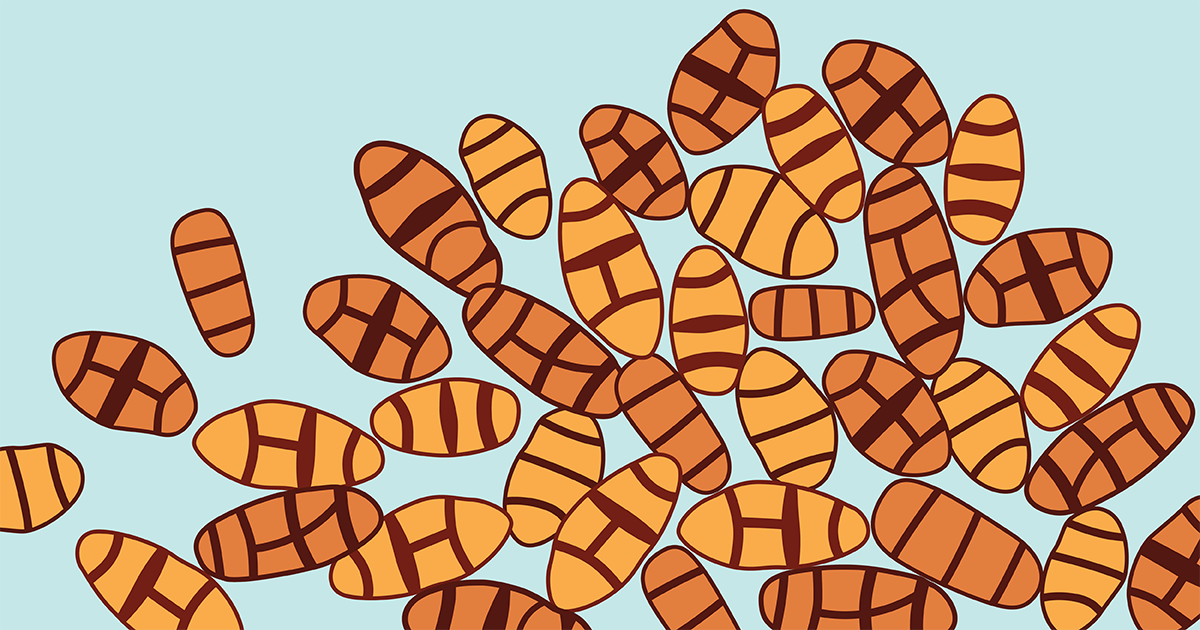
- Measure to manage – Regularly check spore counts in your region and then monitor on your farm. If you don’t monitor, you can’t manage FE risk effectively.
- Watch the weather – FE risk rises when night temperatures stay above 12°C and weekly rainfall is 5 - 35 mm. Be extra alert during these conditions. Typically from January to May.
- Low counts still matter – It’s not just high spore counts that cause damage. Spores eaten over time, even at lower levels, can harm animal health.
- Danger zones – Avoid pastures with very high spore counts:
- 100,000 spores/gram = dangerous
- When pasture spore counts rise to 30,000 spores/gram you should begin planning to mitigate risk to livestock. See Managing on Farm and talk to your veterinarian.
- Risk continues until spores drop – FE remains a threat until spore counts reduce significantly or disappear.
The fungus grows on litter at the base of the pasture, so hard grazing during these high-risk periods increases the chance of animals ingesting spores. Pasture management that allows litter build up also contributes to a higher risk of FE.
Monitoring spore counts is critical for predicting, monitoring and managing FE risk in grazing livestock. If you don’t monitor, you can’t manage.
How to monitor your spore counts
- Start with regional counts - these are your early warning system:
- Your local vet clinic collects spore count data and can send it to you if you request it.
- You can check online at the Awanui Veterinary Lab Portal.
- Sign up for FE txt alerts during the season through your B+LNZ webpage login.
- Do your own pasture counts – Start when regional counts reach 20,000 spores/gram.
This tells you what’s really happening on your farm and help you identify and graze pastures with the lowest risk.
Resources
What to look for
Watch for early signs like reduced feed intake or skin changes.
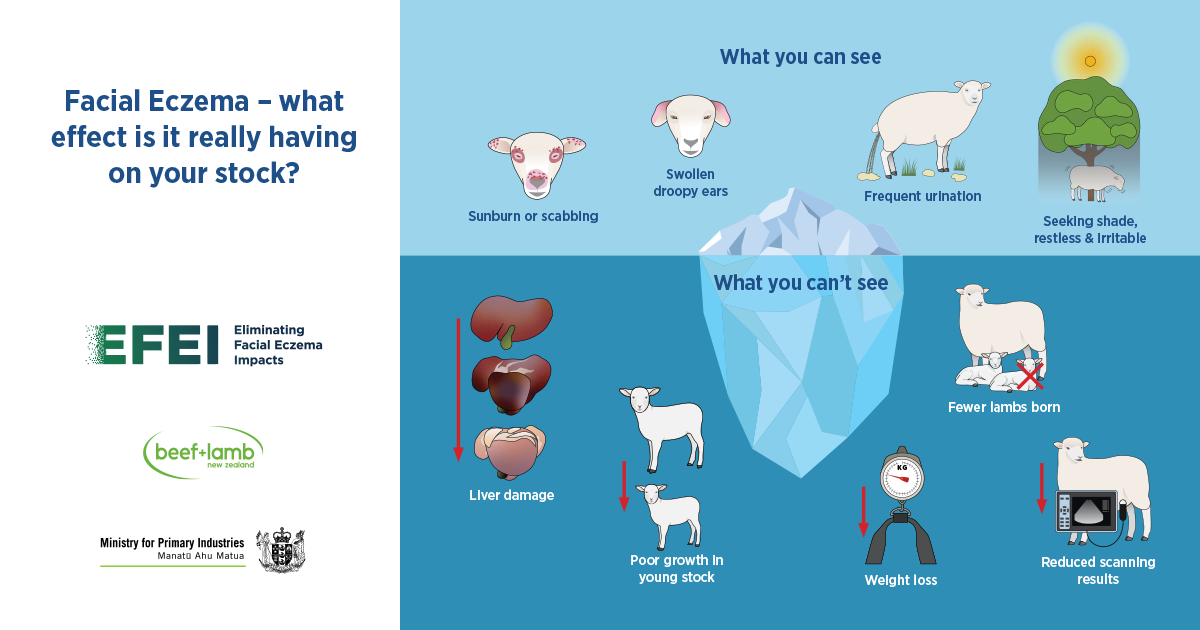
Facial eczema (FE) isn’t confirmed by just one sign. Things like photosensitivity or liver damage as measured by the enzyme Gamma-Glutamyl Transferase (GGT) on their own don’t confirm it’s FE. You need to look at the full picture - multiple signs need to line up before you can be confident it’s the cause.
Hidden signs of facial eczema (also known as sub-clinical)

- Reduced production, such as:
- Poor scanning results.
- Abortions.
- Unexplained weight loss.
- Lower milk production.
- Liver damage confirmed by post-mortem or blood test (GGT over 100 IU/L).
- Occurring in NZ regions where toxic Pseudopithomyces spores are present or FE is known to occur. Check with your vet if spores have been found in your region or check out our Sheep Poo Study findings.
See our Sheep Poo Study Information.
- Watch: Hidden signs of Facial Eczema: Beef.
- Watch: Hidden signs of Facial Eczema: Dairy cattle.
- Watch: Hidden signs of Facial Eczema: Sheep.
Visual signs of facial eczema
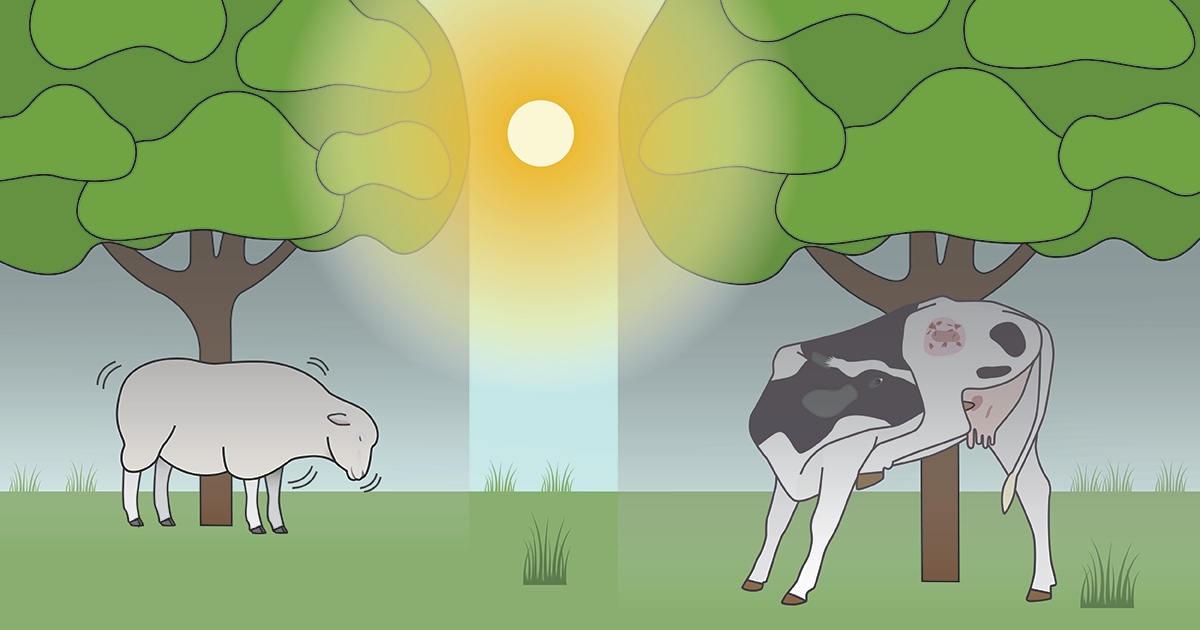
Known as clinical FE.
To know FE is the cause of disease, you need to see one or more of the following visual and behavioural signs:
- Photosensitisation, swelling of ears, face or under side of body including jaw, droopy and/or thickened ears, runny eyes, yellow mucous membranes, sunburn, or scabbing (especially on light-coloured skin), weight loss, poor rumen fill, runny nose, sneezing and difficulty breathing, urine rash.
- Lethargy, depression, rubbing, shade seeking, aggression, or signs of pain or discomfort (colic).
Blood tests with clinical often show liver damage with GGT above 200 IU/L.
These signs usually occur between December and May in New Zealand regions where toxic Pseudopithomyces spores are known to occur, but delayed FE can occur in August – October during times of stress. Other diseases with similar issues need to have been ruled out. For example, liver fluke can also cause elevated GGT and certain plants such as rape can cause photosensitivity.
Resources
- Read: Why clinical cases are just the tip of the iceberg (PDF, 2.17MB).
- Read: Iceberg beef cattle (PDF, 1.4MB)
- Read: Iceberg dairy cattle (PDF, 1.15MB)
- Watch: Liver descriptions.
- Watch: Check those livers.
- Watch: Cutting the livers.
Zinc dosing
If timed right, this can limit impacts .
Protecting animals with zinc:
- Zinc dosing has a prophylactic effect, reducing the effects of the toxin in animals and protecting against FE.
- Can be administered as a zinc bolus, drench or as zinc sulphate in drinking water
- Zinc needs to be provided at the right dose to be effective and it is recommended to monitor the spores each year to know when to start and stop the dosing.
Pasture management helps
Use low risk forages, rotating stock and managing shade can lower exposure.
Feed and forages:
- Use alternative crops such as chicory, brassicas, pure tall fescue pasture.
- Practice lax grazing to avoid the toxic spores which are concentrated in the lower part of the sward.
- Identify “safe” paddocks from historical records of spore counting.
Read:
- Managing Facial Eczema on-farm (PDF, 4.19MB).
- FE by pasture species selection and grazing management (PDF, 51.4KB).
- Tackle Facial Eczema risk with forages (PDF, 554KB).
Breeding for FE Tolerance
Click through to the next section ‘Breeding matters’ to find out about FE tolerant genetics.
A longer-term strategy for herd/flock health.
Genetics - breeding animals for FE tolerance is a medium to long term strategy that:
- Underpins other protective measures.
- Can achieve significant tolerance in 5–10 years if managed well.
- Requires consistent use of certified rams from flocks testing and breeding for FE tolerance