Scanning is a great time to start identifying and managing groups of ewes based on feeding priorities.

Wormwise’s Mary Bowron discusses some of the possible reasons ewes lose condition in early winter – and it’s not necessarily internal parasites.
A kinder autumn across much of the country has left ewes, on average, in better condition, which is showing in improved scanning results in earlier-lambing areas.
However, there will still be ewes that have become light in early winter. These girls are at particular risk of poor lambing performance and poor survival. And it’s very difficult to get weight back on ewes in the last part of pregnancy, so management decisions about these light girls are an early winter job.
Will a drench at scanning help these girls?
It might. But drenching alone is unlikely to be enough.
In a study on five North Island hill country farms, light ewes that were drenched in early winter lost less weight than their skinny counterparts who were left undrenched. However, both groups of light ewes continued to lose weight – highlighting the need to identify these girls and do something more for them, aside from just drenching.
Are parasites the main cause of skinny ewes?
When ewes are under pressure for feed, have another underlying disease or are not coping with being part of a large mob, they can come under pressure from parasites. The parasites might not be the primary problem.
Getting some post-mortems done on light ewes in your flock can be very helpful.
The extended facial eczema season has still wreaked havoc in parts of the country. These light ewes will continue to show up through winter – compromised liver function limits their ability to compete under winter feed conditions. Drench cannot repair burnt liver!
Johnes disease cases can spike if ewes have been under feed pressure earlier in the season. Ewes with Johnes disease can look just like they have worms and it’s really important not to lamb these girls – their progeny are likely to be born with Johne’s, and the ewes will be a big source of infection to other lambs.
The whole-farm worm cost of light ewes
Light ewes frequently have higher faecal egg counts than their better conditioned mates and won’t be helping your pasture contamination situation. Especially if you kept extra lambs on in the autumn to take advantage of high prices!
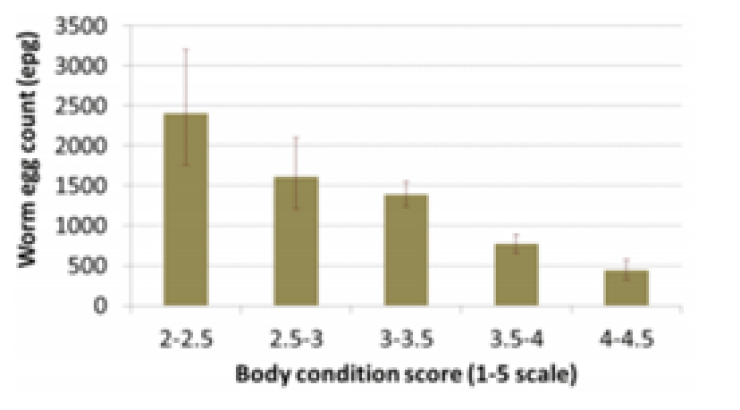
Source: Kahn et al WAAVP 2023 (Merino ewes)
What to do?
Once you’ve scanned, you know who’s who in your flock, and what their feed priorities are. With those priorities in mind, revisit the feed budget, particularly with the risk of El Niño ahead. Make sure younger multiple-bearing ewes have plenty of feed, while fat single-bearing ewes can be used for clean-up duty. Skinny multiples, especially triplets, are at greatest risk of poor lambing performance. Not lambing the worst of these is a valid option. Making a decision earlier rather than later puts you at a better position at set stocking.
For light ewes that you think are worth persevering with, reducing mob pressure and feeding them better to meet their increasing energy demands in the last month or pregnancy are key. Choosing safer lambing paddocks will also help. If you drench these ewes, make sure they are identified so you can observe which ones respond. Often these light ewes are repeat offenders, so identify these girls and consider culling them at weaning time if they make it that far.
How much of a resistance risk is winter ewe drenching?
Probably fairly minimal; environmental conditions are not favourable to high development rates from worms in ewes at this time. The risk is low if only a proportion of the flock are drenched with a short acting product, and especially if drenched ewes are also fed better, allowing their immune systems to deal with any parasites left behind and limit shedding of resistant eggs.