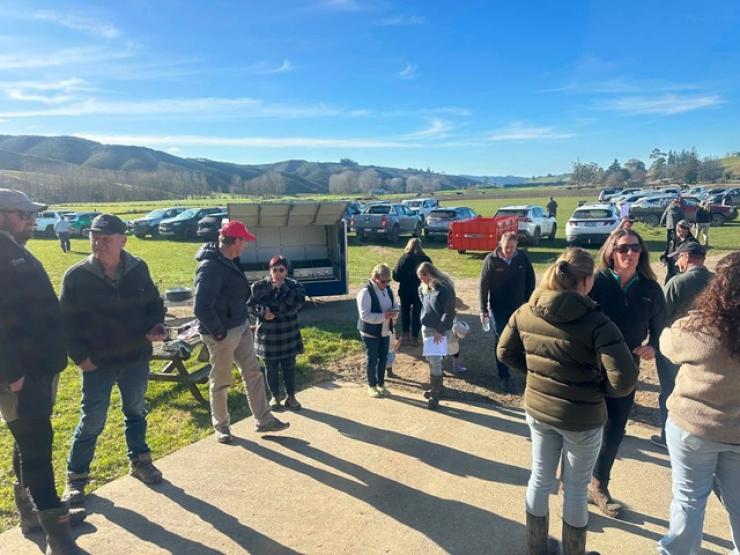
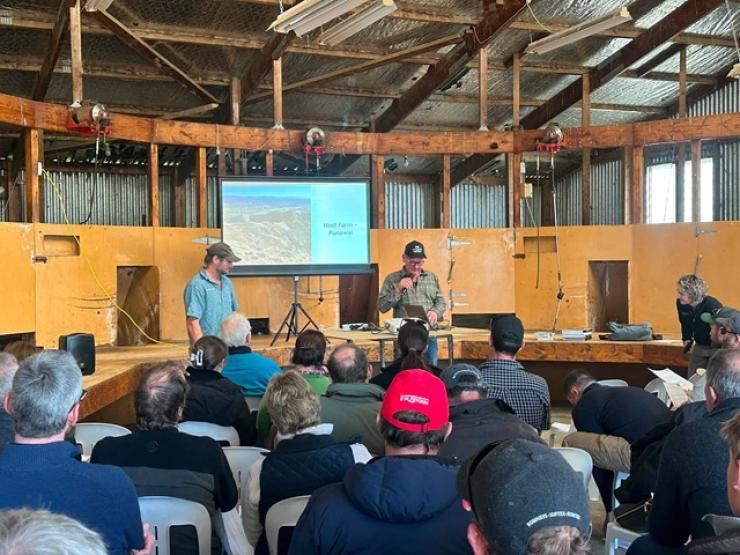
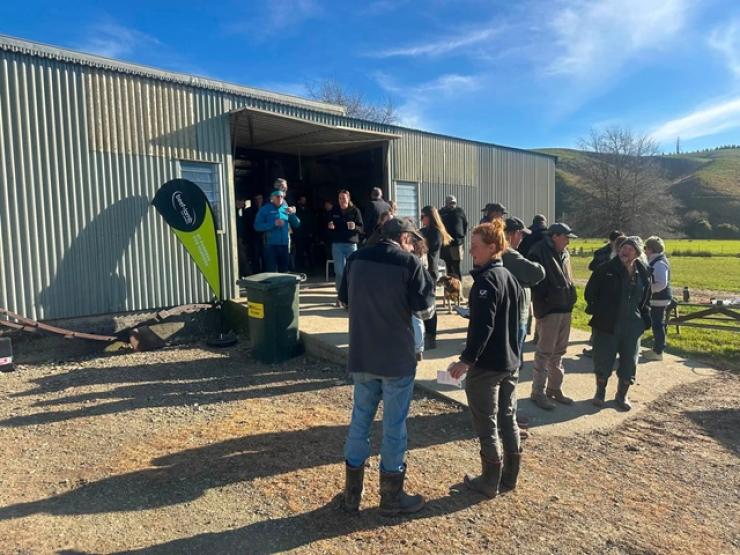
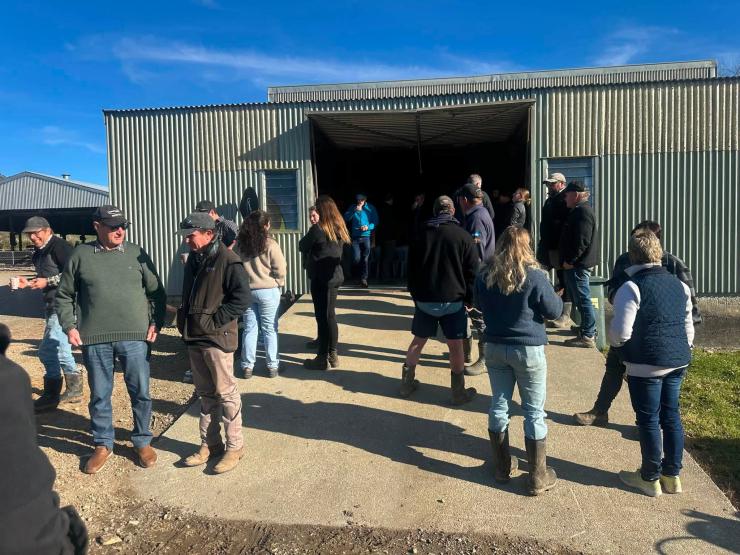
Nearly 70 farmers gathered at Punawai in Eighty Eight Valley for the latest B+LNZ Tasman Farming for Profit field day, which focused on how to grow more kilograms out the gate and lift farm profitability.

Hosted by Ian and Hamish Parkes, the 'KG is King' event, organised by Beef + Lamb New Zealand (B+LNZ) on behalf of the Tasman Farming for Profit committee, brought together farmers and industry experts to explore the practical management, feeding and breeding decisions that drive more kilograms out the gate.
The clear takeaway from the day was that lifting productivity comes down to getting the basics right: matching feed supply and demand, maintaining ewe condition, growing heavier lambs, making smarter breeding decisions and measuring the kilograms produced from every hectare.
Building kilograms one hectare at a time
The afternoon began with an overview of Punawai farm, where six generations of the Parkes family have farmed in Eighty Eight Valley, Tasman.
The property has grown from around 3,000 stock units in 1980 to approximately 8,600 stock units today, driven by continual development, investment and a strong focus on production.
Hamish Parkes shared how the farm uses Farmax to monitor pasture covers, feed demand and livestock performance, with total meat and wool production per hectare sitting at the heart of the farm's decision-making.
Some of the key figures shared included:
- Current meat and wool production of 225kg/ha, with a long-term target of 257kg/ha.
- Stocking rates increasing from a long-term average of 8.3SU/ha to 9.6SU/ha in the past year.
- Lamb growth rates averaging 150g/day and tracking toward a target of 160g/day.
The Parkes family highlighted the importance of measuring the things that matter and keeping a clear focus on kilograms produced per hectare.
More profit starts with the ewe
Dr Rene Corner-Thomas (Massey University) focused on one of the biggest opportunities available to sheep farmers: getting the most from their ewe flock.
A key message from her presentation was that heavier lambs often create more profit than simply increasing lambing percentage.
Heavier lambs are more efficient, require less feed per kilogram of saleable product, are often sold earlier and free up feed for other stock classes.
Throughout the session, Rene repeatedly returned to ewe body condition score as one of the most important drivers of productivity.
Ewes in good condition are more likely to survive, stay productive for longer, produce more milk and raise heavier lambs.
One of Rene's standout message was: "You're not breeding ewes, you're breeding dairy ewes."
She explained that milk production plays a huge role in lamb growth during the first month of life, making ewe nutrition during late pregnancy critical.
Farmers were also encouraged to prioritise feeding for multiples and lighter-condition ewes, while continuing to focus on lamb survival through good nutrition, strong colostrum supply, effective mothering ability and sound paddock management.
Another practical reminder was not to overlook udder health. Ewes with udder defects consistently weaned lighter lambs and achieved poorer lamb survival outcomes, making post-weaning udder checks an important culling tool.
The cheapest kilograms you'll ever buy
Dr Mark Ferguson (NextGen Agri) shifted the focus to genetics, challenging farmers to think of breeding decisions as long-term investments.
"The cheapest kilograms you'll ever buy are the ones that come through better genetics," he said.
Mark encouraged farmers to use performance data and breeding values when selecting rams and bulls, rather than relying on visual appearance alone.
"The only thing that comes home with you is the genetics," he added.
Farmers were challenged to develop breeding plans based on four key questions:
- Will this animal make me money?
- Will it save me money?
- Will it save me time?
- Will it delight the customer?
Mark highlighted opportunities to improve profitability through traits such as fertility, growth, lamb survival, worm resistance, dag score and body condition score.
He also reinforced that faster-growing animals are often more efficient because they spend fewer days on farm, require fewer treatments and free up feed for other stock classes.
While production gains are important, he reminded farmers not to lose sight of the customer, with eating quality and product consistency remaining critical to New Zealand's competitive advantage.
Key takeaways
Across all presentations, several common themes emerged:
- Measure kilograms produced per hectare and track progress over time.
- Focus on producing heavier, more efficient lambs.
- Prioritise ewe body condition score.
- Feed multiples and lighter-condition ewes first.
- Use genetics as a long-term tool to improve productivity.
- Buy breeding stock using data and performance information.
- Consider traits that improve profitability, reduce labour and strengthen resilience.
- Keep customer expectations and eating quality front of mind.
B+LNZ strategy for more profitable and productive farmers
B+LNZ Chair Kate Acland linked the day's theme to B+LNZ's long-term strategy for a more profitable, productive and resilient sheep and beef sector.
Kate highlighted that meat production remains one of the strongest drivers of farm profitability across New Zealand, with improvements expected through better feed utilisation, genetics, animal performance and farm management.
She said that while sheep numbers have declined significantly over recent decades, gains in genetics and management have helped maintain lamb production, showing what is possible when the sector focuses on productivity.
Thank you
B+LNZ extends its thanks to the Parkes family and wider Punawai team for opening their gates and sharing both their farming journey and farm performance data.
A big thanks to the Tasman Farming for Profit committee for providing the them and ideas behind this event.
Thanks also to B+LNZ Chair Kate Acland, Dr Rene Corner-Thomas (Massey University) and Dr Mark Ferguson (neXt gen Agri) for sharing practical insights on farm performance, sheep productivity and genetics.