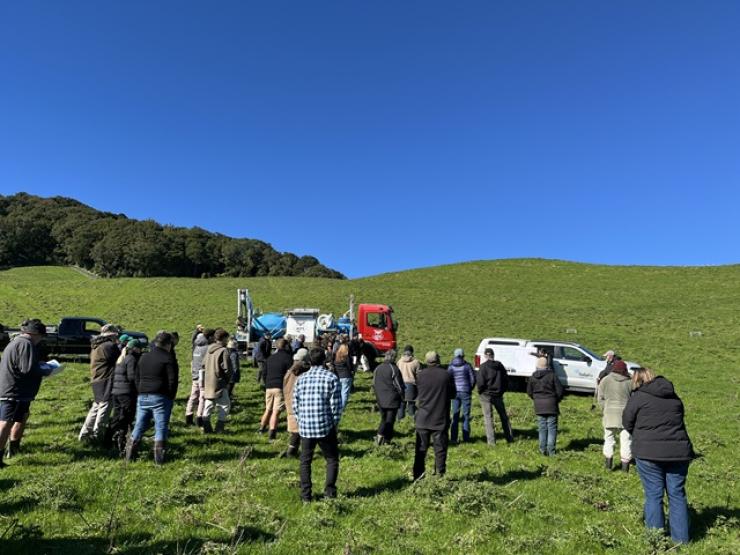
A B+LNZ-supported field day at Bill and Sue Garland’s Rahiri Farm earlier this year tackled a question plenty of hill country farmers will relate to: how do you get more out of the parts of your farm that never quite pull their weight?

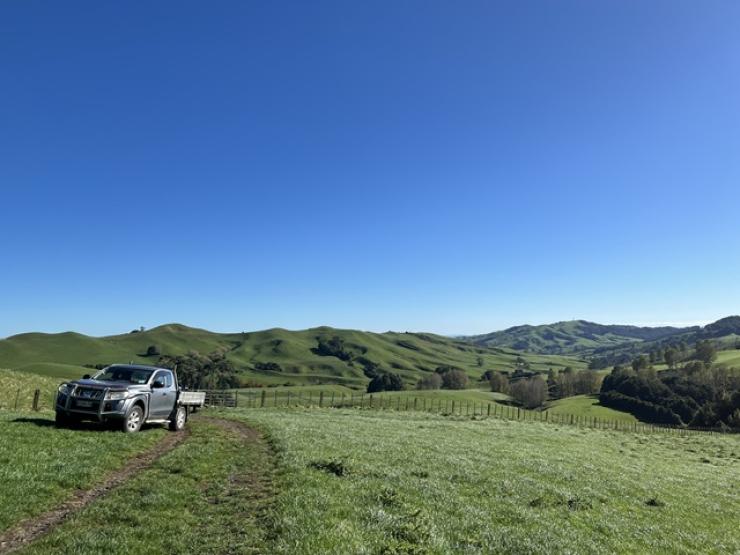
At Rahiri, that is the sidelings, making up around 160ha of the 420ha farm. Like many hill country farms this steep, improving them has been difficult. Steep terrain, lower fertility and limited access have all played a part.
For Bill Garland, the sidelings have always been a challenge.
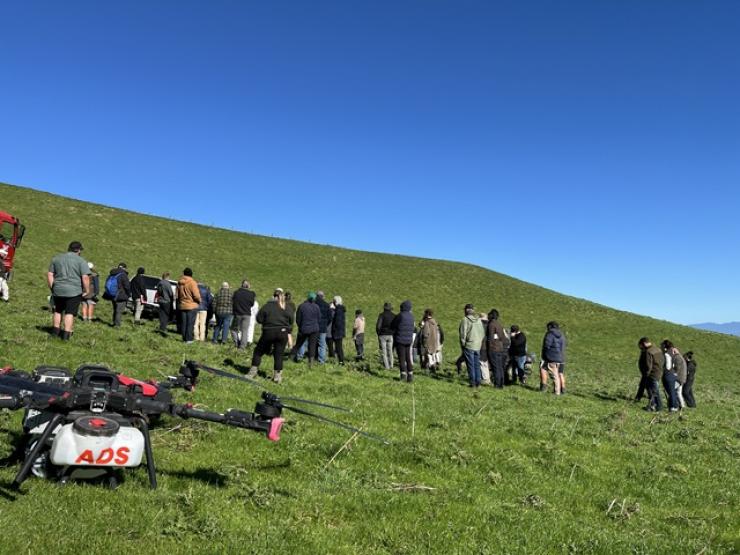
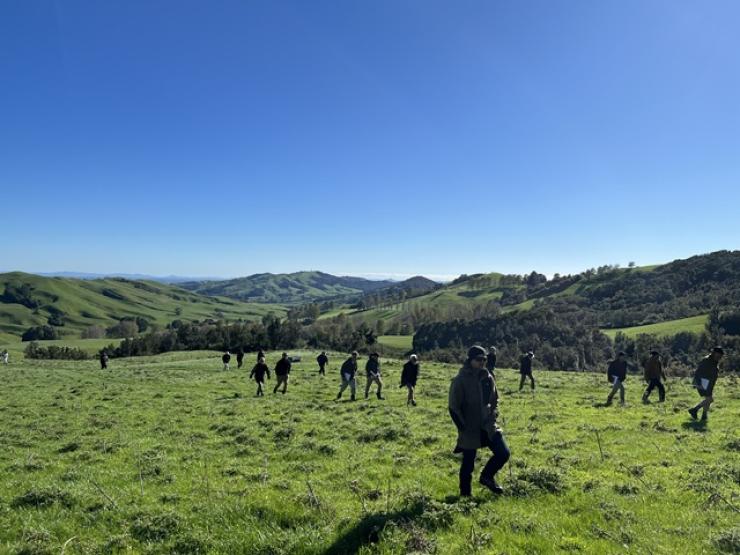
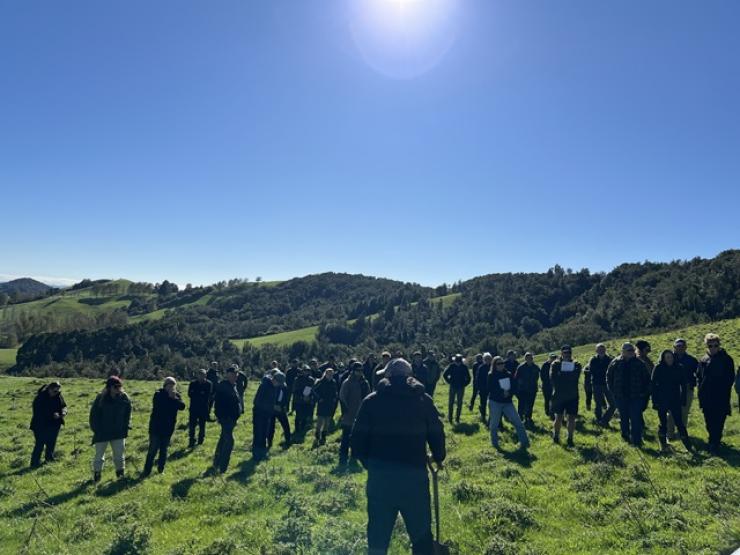
The field day brought together farmers, researchers and industry partners to look at a practical, on-farm approach to tackling that challenge by stacking the technologies of deferred grazing, drone oversowing and targeted fertiliser application.
The work is part of a wider programme led by the Bioeconomy Science Institute (BSI), funded through the Ministry of Primary Industries’ Sustainable Food and Fibre Futures (SFFF) programme, which aims to improve practical grazing management options for hill country farmers, and is supported by B+LNZ and other industry partners.
This project is built around a long-standing relationship with farm owner Bill Garland.
“We’ve worked with Bill for many years, and he’s been using deferred grazing for a long time,” says BSI researcher Tracy Dale. “He understands how to manage deferred pasture and get the benefits from it. If anyone was going to give this a good go, it was Bill.”
A paddock-scale approach
Rather than a small-scale plot trial, the work at Rahiri has focused on a 10-hectare demonstration paddock.
Bill approached the project team looking for ways to improve underperforming sidlings and to revisit oversowing into deferred pasture, which hadn’t delivered the results he’d hoped for in the past.
“We had also done some smaller plot trial work looking at oversowing into deferred pasture and hadn’t had much success,” Tracy says. “This was about trying to bring all our learnings together and testing it properly at paddock scale.”
Starting with deferred grazing - a new way of thinking about the litter layer
The starting point was deferred grazing, with the paddock ‘shut up’ in late spring, allowing the pasture to go to seed and build up a litter layer before being grazed by ewes in late February.
Traditionally, deferred grazing has been used to help pastures recover, build seed reserves and provide feed later in the season. In this project, the litter layer created through deferred grazing was also used as a seedbed for oversowing.
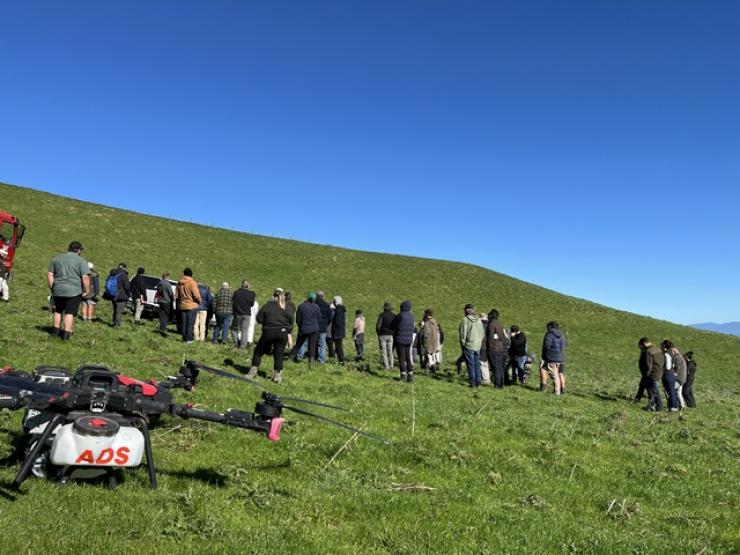
Just prior to stock being taken out of the paddock after grazing the deferred pasture, a drone was used to oversow seed across both the easier faces and the steep, hard-to-reach areas.
The drone was one of the highlights of the field day.
“People were really keen to see the drone in action” Tracy says “because it’s a technology more farmers are using.”
However, the drone was only one part of story.
“The drone gets the seed there,” says Tracy “what happens after that depends on a whole range of things – seed size, seed coating, soil moisture, thickness of the litter layer and how well it’s grazed - getting good seed-to-soil contact is critical.”
Targeted fertiliser application is another important part of improving the paddocks productivity. Much of the steeper country at Rahiri has historically received less fertiliser because of access limitations. Bill knew that soil fertility needed to be addressed for introducing new pasture species.
"You've got to tailor the fertiliser plan to target those lower fertility areas," Tracy says. " Otherwise, you're asking those plants to establish in an environment that's already working against them."
Early monitoring has begun to show promising results.
The easier parts of the paddock have responded well. Ryegrass has successfully reseeded following deferred grazing, and oversown species have established well where conditions are more favourable. “We take this as proof-of-concept success and more importantly, Bill is happy with the way the paddock is progressing” says Tracy.
The sidelings have been more challenging. In some areas, seed has remained in the thicker litter layer without establishing, reinforcing the importance of getting the grazing management right.
Rather than seeing those challenges as a setback, Tracy says they provide valuable learnings for Bill that he can use in future years.
"Doing this work on a commercial farm means we see the challenges farmers face every day," she says. "That's how we learn what will actually work in practice."
The field day also reinforced that improving hill country is about looking at the whole system. Alongside the paddock walk with Bill, attendees heard from Katie Aitkenhead (Ballance Agri-Nutrients) about addressing fertility constraints, Allan Turner-Ballantyne (ADS Agri Drone Services Ltd). Steve Howarth (AgFirst) discussed the economics of deferred grazing and oversowing, and Trevor Cook talked about his experience with deferred grazing and animal performance.
One of the key take-home messages was that there is no silver bullet for improving hill country pastures. Progress comes from combining practical tools, understanding how they interact and making small improvements over time. As Bill puts it, it’s about “making small improvements that add up over time.”
What’s next
While the Rahiri demonstration paddock will continue to be monitored into spring, the focus is now shifting towards helping more farmers put these ideas into practice on their own farms.
"We're looking at creating small farmer support groups where farmers can give deferred grazing a go, learn from each other and ask questions as they go. Every farmer has their own reason for using deferred grazing, but farmers learn best from other farmers making field days like these so important,” Tracy says.